Showing posts with label Newbie. Show all posts

Monday, February 25, 2019

The RV Waste Treatment Tanks (The Black & Grey)

I do not plan on explaining how to dump the grey and black tanks on your RV.  What I would like to do is to explain how to stay out of trouble in dumping your tanks and dis-spell some of the myths on when to dump your tanks.


So what are the main differences between sticks and bricks waste disposal and your RV?  First, there is no worry about getting rid of the waste at your sticks and bricks.  You let water splash into the sink and it just disappears down the drain.  No matter how much water you put into the sink.  You flush the toilet you never have to worry about sewer smell coming back-up and if the toilet gets clogged up you just plunge a few times and presto the waste is gone.

None of the above is true for your RV.  If you put too much water down your sink, you will overfill the grey water tank and the wastewater will flow into your bathtub or shower.  If you leave your waste slinky hose hooked up with the open/close valve on you RV open you will invite sewer gas and some critters, from the campground into your RV.
Do not leave your black tank dump valve open all the time when hooked to the campground sewer line.
Because your toilet is on top of your black water tank there is a limit to how much waste you can put down there as well.  Also if it gets plugged up, plunging it will not help!
So what to do.  For the smell problem that might occur in the grey water tank, I use Grey Water Tank Smell Killer.  It works. You should put a cup of Dawn Liquid Dish Soap down the kitchen sink once a month to break up grease and oil in the Grey Tank and sink P traps.
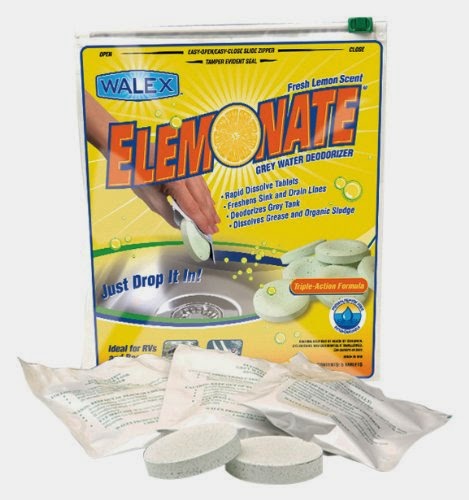
Grey Water Tank Smell Killer

As for the water back-up, you should dump your grey tank every two days while camping or sooner if the water starts to back up.  This is the tank you can dump before you leave for home.
The grey water tank should be the last tank you dump before you head for home.  After dumping it you need to add approximately 1 gallon of clean water back into it and one of the grey water tank smell killers and you are good to go.
BLACK WATER TANK

Now the black water tank the scourge of RV camping.  There are a lot of does and don'ts about this tank so let's get started.
No matter what you hear or read almost all of the sensors that are supposed to tell you how full the black water tank is, do not work.  I have been told and it has been proven that the sensors mounted on the outside of the tank do seem to do a better job than those sensors that are inside the blackwater tank.  Most of the crazy ideas floating around about how to make the sensors inside the black water tank work also do not work.  To fix the problem of, the black water tank sensors and how full is the blackwater tank.  So, how do you know when it is time to dump the tank?  Look down inside the toilet and if you see blackwater, hear gurgling, and stuff floating, it's time to dump the tank.
 So what can you do to improve how the black water tank works.
Use only quick dissolving toilet paper in this tank.  Toilet paper made just for RV is fine such as RV 2ply Toilet Paper or septic tank safe toilet paper.  But you can use just about any toilet paper that will quickly dissolve.  To test any brand of toilet paper to see if it can be used,  take a glass jar with a lid.  Fill the jar about 3/4 full and add a single sheet of your toilet paper to be tested.  Put on the lid and give the jar three quick shakes.  If most of the sheet of toilet paper is broken up and coming apart you are ok to use the toilet paper tested.

Check here for more details RV Toilet Paper Safe.

We have safe paper what next?  How about something to get rid of the smell and help break down the waste. I would suggest a Black Holding Tank Deodorizer and Dissolver
Black Holding Tank Deodorizer and Dissolver

This should be added to your black water tank regularly.  I add one tablet after each time I dump my black water tank and another during hot weather if there is a smell problem.
Oxy-Kem 


Here is another possible black tank treatment Oxy-Kem that comes highly recommended.  I have not tried it so I can't comment on how well it works, but I do plan to and will let you know.  I did get a chance to try the Oxy-Kem.  However, it was not very successful.

Here is an all natural black tank cleaner that really cleans the tank as well as the sensors.  I have not tried it myself but all of the reports I am getting say it works. Unique Black Tank Cleaner  I have tried this black tank cleaner and found that I did not like it and have stopped using it.


Lately, I have been using Firebelly Outfitters, Tank Deodorizer.  I use two packs of the deodorizer per black tank.

I have used the product for several months now and have found positive results so far.  Another positive thing is that the people who make and sell this product are RVers.

Do not dump your black tank unless it is full or nearly full.  I know what you must be thinking but we never get it full over a weekend trip.  I realize that maybe the case but, you need to fill it up manually and dump it before you leave the park.
You do not need a hose or make this a big deal just flush the toilet and insert one of these things.
 Johnny Chock


Johnny Chock
          
Let the toilet run for approximately 10 to 15 minutes depending on how full your tank is.  If you can see the water in the black tank from the toilet that is full enough.  Remove the Johnny Chock and store.  Now dump the black tank like you usually do.  Add about a gallon or more of water (you can run the toilet with the Johnny Chock for 2 to 3 minutes and that should do it.  Drop in one of your black tank tablets and you are ready for the next outing.

Never leave the black tank drain valve open.  You are just asking for the smells of your neighbor's sewer to come up into your RV.  Or if you are really unlucky you could get the "black pyramid of death".  Because the liquid drains out of the open drain valve quickly the black solids are left behind and start to pile up.  If air gets into the tank from the open valve and drys out the solids you are really in trouble.  Or if you dump your black holding tank too frequently you will also have a build up of the solid waste.  This is a problem you do not want the black pyramid and could cause a very expensive repair.  To prevent the "pyramid of death" you need to flush your black tank when it is at least 3/4 full and refill it so that there is some water splashing inside as you drive back home.

One of the things you hear and I have tried is to add one cup of cheap dishwashing liquid soap to break-up waste and Calgon to lube the inside of the tank.  Does it work?  I have been using it and have not seen much of an improvement.  I plan on using this in the grey water tank next to see if it makes a difference to that tank.


Quick Guide To Waste Tank Dumping
  1. Grey Water Tank can be dumped anytime.
  2. Use a tank treatment when needed. (to reduce smell and add microbes)
  3. Dump Black Tank when at least 3/4 full.
  4. Add a small amount of water to both tanks after dumping. (up to 2 gallons)
  5. Use the grey water to flush out sewer hoses.


Until Next Time.


Monday, November 12, 2018

RV Humidity -- An RV Rig Killer!

A strong title, but true.  One of the major killers of RV walls is moisture in the form of humidity.  You don't even have to be using your RV it can be sitting in storage and humidity can still be present on the inside above a safe level.  Mold depends on moisture to grow and flourish. What is a person to do?  Well, the safe level of humidity for an RV is 40% or thereabouts.  So the first thing you need to do is know your current humidity level and the best way to know that is with a humidity monitor.


In the photo for the Humidity Monitor, the screen is showing 53% which is not acceptable for an RV.  The reading shown is more likely a Sticks&Bricks house.
Now that you know what the humidity is.  What can or should you do if it is not right.  You need to try and find out the source of the moisture causing the high humidity.  People give off moisture when we breathe, but getting rid of all the kids is not an option be they fur or not.

Next showers or taking a bath gives off moisture.  Be sure that the bathroom fan is turned on during the bathing process, even in the colder months.  Wipe down the shower and bath area to reduce the amount of moisture that is evaporated back into the air of the RV.

Cooking is another moisture generator.  Keep lids on pans when cooking, to keep the moisture down, open a window a bit to let the warm moist air out, and turn on the kitchen vent if you have one.  Many of the newer RVs do not vent the stove vent to the outside.  This is not good, as an inside vented stove hood keeps the moist air inside the RV.  Do not let a tea kettle steam longer that is necessary.  Don't leave a coffee pot running all day long.  Make a cup as you need it or the coffee pot will add to the humidity in the RV all day long.

Try to locate any seals in the RV slides that is letting in outside air and seal that area.  You can cut strips of foam insulation like Reflectix or other foam insulation.  If you find caulking around the tub or shower stall or even around the kitchen/ bathroom sink is missing or cracking re-caulk using 100% silicone sealant like shown below.  This keeps water from going in the RV wood structure or supports where, if conditions are right, mold will start to grow.

If it is during the colder months and your RV has single pane windows you might add Bubble Wrap to the windows.
To install the bubble wrap do the following.

Cut the bubble wrap to the size of the window pane with scissors.
Spray a film of water on the window using a spray bottle.

Apply the bubble wrap while the window is still wet and press it into place.
The bubble side goes toward the glass.
To remove the bubble wrap, just pull it off starting from a corner.

This bubble wrap will help insulate the inside of the window from the outside of the window to further reduce moisture forming on the inside of the window when the outside air is colder than the inside air.

Do you dry clothes in the RV by hanging them in the bathroom?  Did you remember to turn on the exhaust fan?  It is not wise to dry clothes in the RV during the colder months because drying clothes adds to the amount of moisture inside the RV.  Do you have a combination washer/dryer?  Make sure the dryer is vented to the outside.  If you do not the dryer will add to the moisture in the RV.

If it possible let the RV inside temperature drop a bit in colder weather so the air inside the RV will hold less moisture.  Cooler air holds less moisture than warm air.  You may have to dress a bit warmer, but your RV investment will thank you for being a bit cooler.

Poor air circulation inside the RV can make mold grow in drawers, closets, and even cabinets.  Keep the air moving even when you are not inside your RV.  How may you ask? You can open two or more roof vents or a roof vent and crack a window so that air naturally flows in and out.  You can add a MaxxAir vent cover

over your current roof vents so that you can keep your vents open without rain or snow coming in the RV when the roof vent is open. You should put your RV in storage with vents cracked a little bit to allow for air movement.

If your RV does not have LED lighting you could swap out your current incandescent light bulbs for the LED equivalent.  This will reduce the about of air heating that the hotter incandescent bulbs are known for.  There is an LED replacement light for most all of the RV incandescent bulbs used in RVs. As an additional benefit, your RV battery will last longer during dry camping with LED lighting and depending on the LED light you buy you may find that the inside of your RV is now brighter with the lights on.

OK, we have talked about what not to do and some of what you can do to reduce moisture in the RV now let's get serious about stopping or greatly reducing moisture in your RV.
1. Get a dehumidifier.  They come in several sizes and types.
The ezest one to do business with is the bead type.

Twin Pack resealable packaging
100% silent operation
Lasts 45-60 Days
Indicator beads let you know when it's ready to be discarded.

You can spot these around the RV and in closets, cabinets, drawers where ever you feel or think moisture may be lurking.
Next, you have the mechanical dehumidifiers.

Whisper quiet
Renewable reservoir
Compact size is perfect for bathrooms, closets, and R.V.s
Low energy consumption
One of these usually works but if you have a severe problem you may want to consider two of them.

If you have an RV more than 36 feet long you may want to consider this one.

Squeezes Up to 20 oz. of Water a Day From Humid Air
Very Quiet Operation Due to No Moving Parts
At Capacity, Indicator Lights Up and Device Shuts Off
Compact at 4.45 pounds, 6.8" x 8.5" x 14"
For bunkhouse RVs,  you will need two.

And if you really need more moisture removal you can use a sticks and bricks type unit.
Removes up to 70 pints of moisture from the air per day
1.3-gallon water tank with transparent water level indicator, full bucket alert, and automatic shut-off when full
Removable, easy-cleaning dust filter with a clean filter alert
4 durable, rolling casters for easy movement

 It is generally felt that combinations of dry and mechanical work the best.

Well, that should about do it for this topic.  I hope you found the information helpful and can use some of the ideas presented.

Until Next Time


And finally, please remember that this blog is an Amazon affiliate. When you order something through any of the Amazon links, it doesn’t add anything to your cost, but I do earn a small commission on everything you buy. Just click on an Amazon link, then shop as usual.

Saturday, August 18, 2018

Can You Hear Me Now? Breaker Breaker 1... 9.....

For this post, I would like to discuss keeping in touch with the family while camping.  Many people in the good old days, used string and two soup cans or a CB walkie-talkie to keep in touch with family members during camping.  Most of the campers in the olden time and even RVers today, nothing was or is used to stay in touch.  While some may believe that a cell phone is good enough, and it may be traveling down the interstate, in a campground in the wilderness or at the nearby lake you may find that the good old cell phone does not work, even a little.   You may find that the carrier you have is the wrong carrier for good service in the area that you are in and that the other guy would have been a better choice.  Whatever the case, today we have very small radios called FRS/GMRS that will last a long time on batteries, give you several miles of range, be quiet and can even be set up for "selective call" so only your family members will hear you when you call them in for lunch or are backing up the rig.  RVers who are backpackers take note, these little radios can have weather radios and GPS built-in as well.


Let's take a look at a few [shown below] and discuss their features and benefits in more detail.

Shown above are some Basic FRS radios.  They come as a pair when you buy them and have the following feature set.  The units come with rechargeable batteries, two belt clips, charging cable, AC adapter and have a range of 20 miles over flat and open terrain.  They offer a 12hr battery life.  As you can see the unit does not offer a lot of features but it works and could be used when backing the RV into that tight site, right next to the lake.


Above is shown a step-up model of an FRS/GMRS radio.  It can run on alkaline batteries for up to 10hrs or 8hrs on rechargeable batteries.  This model from Motorola includes 11 weather channels, 22 talk channels, and each channel has 121 privacy codes, (selective call)  for privacy.  The range is 23 miles over flat and open terrain.  It comes with belt clips and 1 dual drop-in charger to charge the pair of radios at the same time to save you time.  Use one as a base station at the RV and give the other one to whoever you want to keep track of.  Additional units can be purchased so everyone who needs one has one.  This unit would be great for a fisherman to keep in touch while out in the boat on the lake.


 Calling all Backpacking RVers out there.  Here is an FRS/GMRS radio that has a built-in GPS or a GPS that has a built-in FRS/GMRS radio.  This unit is not low cost, but it does show that just about any need for communications while RVing can be met with an FRS/GMRS radio.  For the fun of it here are some of the features of this radio.  The radio has a 2.6-inch color touchscreen that is glove friendly.  A high sensitivity GPS receiver, a rugged waterproof case. Runs 18hrs on a set of batteries, and has a list of accessories as long as your arm. 
While most of us will want a lower cost unit you need not suffer from little to no features.  Range, the number of channels, the privacy feature (selective call), and battery life are the important ones to watch out for.
Safety and peace of mind make the weekend RV getaway fun and exciting for the whole family and the ability to stay in touch with all members of the camping party does that for me and my family.


Until next time.  Over and Out?

Saturday, March 24, 2018

Bugs, Bugs, And More Bugs


Now that Spring has finally sprung, and Summer is on the way, it is time for the bugs of the RV campgrounds to rise up against their camping overlords.  I am sure that you have had your fair share of bugs either the crawling type or the buzzbomb type. I will try to give you some hints and tips on how to get rid of both types safely and cheaply.


 So let's go.
Ants
Ants we all seem to collect them either during storage or while camping. Here is a cheap and pet safe way to get rid of them both in the RV or your sticks and bricks.

You need to mix in equal parts of,

1 part baking soda
           and
1 part powdered sugar (not the granulated kind used in coffee)

You will need.
   
1 lid from any jar

Mix the baking soda and powdered sugar and put into jar lid and put out where you have seen the ants. It will not be long and the ants will be gone. So you may ask why this works. Inside of ants, there is an acid type fluid when mixed with the baking soda causes the ants to explode. If you or the dog should eat the mixture nothing much happens, it just doesn't taste good.

Cornmeal is another safe way to get rid of ants, but it can be a bit messy. Just sprinkle the meal around the nesting area or along the ant trail. In a day or so the ants will be gone.


Stink Bugs
These little devils are not native to the USA but, like many of our ancestors have immigrated to a better life here in the USA. So how do you get rid of them now that they have hitched a ride in your RV?

In a spray bottle, combine 32 ounces of hot water and three-quarters of a cup of Dawn dishwashing liquid and spray the exterior of your RV's, windows, and doors. On the inside spray around baseboards inside cabinets, closets, and any other dark area inside the RV. For an extra kick, you can use the anti-bacterial variety of dishwashing liquid, but understand that it contains additional chemicals. Of course, a good bug spray will also work but might not be safe for Fido.


Wasps

You are getting your RV ready to go for spring and you spie a wasps nest or several wasps returning to the same spot time after time. What can you do? Well spray the area or nest with WD40 and that will rid you of the nest or neutralize the area that the wasps were going to use to build their nest.

There are also a variety of commercially made glass wasp traps that claim that they are helpful in reducing wasp populations in the area. The trick is to make sure you keep replacing the bait, as wasps like fresh bait. And also, please consider using savory bait, such as tuna, as that will attract the yellow jackets and wasps, but not honeybees, which a sweet bait will. The glass traps are actually very pretty, but you can also make your own inexpensive version out of any type of plastic bottle (soda pop bottle, or water bottle). 
Follow these instructions to make your own.


Mud Dauber (Wasp)

While these wasps are non-aggressive to humans, they do cause problems to RVers by getting into places they should not be.  Like gas orifices of the heating system, hot water system, and refrigerator.  The best defense here is to plug the holes leading into these areas of the RV.  
See below for screening suggestions to keep them out of your RV.


Mosquito
The scourge of the RV camping experience the Mosquito. First, how do you keep them off you? Use Skin-So-Soft. You can purchase here Skin-So-Soft and it really does work for several hours. It is safe for kids and does not contain Deets. However during scientific tests, Deep Woods Off, proved to be the best you could buy in keeping Mosquitoes away from you. BUT it does contain DEETS. Please be careful when using Deets around children. Be sure to follow directions for use of the product.

So what about those flying around? We need to construct a mosquito trap.
Please follow this link to "Wiki How" to see how it is done. 

Bait the trap. Mix 1/4 cup of Brown Sugar with 8oz of hot water. Mix thoroughly and allow to cool. After the mixture cools, pour into the bottom of the plastic bottle. Add 1/4 TSP of Yeast. 
DO NOT MIX!!! The mixture gives off carbon dioxide that attracts the Mosquitoes.
Once the Mosquitoes are tricked into going in they can't figure out how to get out, so they get trapped and die.
Dispose of the Mosquito trap regularly whenever the number of dead Mosquitoes does not appear to be increasing.

 You have saved the planet and your camping area from thousands (well maybe hundreds) of Mosquitoes.
We thank you!

So how do you stop or slow down bugs getting into your RV when the front door is kept closed most of the time?  You put screens over the openings caused by the water heater, furnace, and refrigerator.
Let's take each one and see what can be done.
Water heater.  You can buy a water heater vent screen, such as this one, Flying Insect Screen


and install it (easy DIY project) over the water heater RV vent.  I have a KZ Spree and could not find a water heater vent cover so I covered the inside of the water heater cover louvers with insect screen and used silicone to bond the screen to the metal water heater cover.  Works great.
Furnace vent. You can buy a furnace vent screen, such as this one, RV Furnace Screen


The kit comes with everything you need and will keep the Mud Daubers out.
Refrigerator Vents.  You can buy a refrigerator vent screen, such as this one, Refrigerator Vent Screens


I installed these on my Open Range 5er and use some zip ties to hold the screens in place so they would not move around.  This was a simple DIY project and will keep the bugs and Mud Daubers out.  Check around windows and doors for any cracks or small openings that may have developed and keep storage doors closed while camping and you should keep the bugs out and enjoy the indoors as much as the outdoors.


Until Next Time.


And finally, please remember that this blog is an Amazon affiliate. When you order something through any of the Amazon links, it doesn’t add anything to your cost, but I do earn a small commission on everything you buy. 
Just click on an Amazon link, then shop as usual.

Friday, February 16, 2018

12 Volt Emergency Power & Emergency Tire Pump

When you dash off for a weekend camping vacation, most of us just don't sweat the details.  I know, I don't and that is what gets us all into trouble.  Last camping season,  the wife, grandkids, and I headed out for just such a weekend.  It was early in the season and when we got to the campsite we were the only ones around.


So far so good.  We had a great time exploring the Spring outdoors and when we were ready to go the truck would not start.  Normally that would not be a problem because we would have lots of fellow campers around us to help out.  Not this time.  There also was the time we were on our way to Branson MO to meet relatives, when one of the trailer tires decided to blow and the spare was nearly flat.  Forgot to air up the spare tire at the beginning of camping season.  Hey, it happens.  Short term memory fading as I get older.
All of this drove home the point that Murphy is always with us and bad thing happen to good people as well.  So what is the solution?  One of these, 12Volt Emergency Power & Tire Pump
What this thing does is provide emergency power to start your truck not all of the units that look like this one will start a V8 or larger engine, as well as an air station to pump-up just about anything that needs air.  You can use a standard AC extension cord as the power cord to charge the unit up.  You can even leave it plugged in for a continuous charge and not damage the unit.  Oh, it does have a DC output jack that may be used for 12volt stuff.  Also, it has a built-in tire pump that will pump up most TT and 5th wheel tires.  Again many of these combo units can't pump up RVs tires before the cows come home.  As always be sure you check your rigs tire pressure when the tire is cold not when it has been run on the road for several hours.

Due to the fact that newer 5th wheels are using tires that require more pressure than the above unit can provide.  I am suggesting that you might want to take a look at the following RV Tire Pump.  While this unit will not start your car or truck in will pump up RV tires up to 150 lbs.
High-Pressure RV Tire Pump


But I hear you say that you needed something that had AC power like the 110volts that comes out of the power pedestal that your RV is plugged into.  Fear not, because you can use one of these, 110volt and USB Dual Power Inverter

The 300W DC-AC Power Inverter with USB charging ports is designed for most major brand notebook computers, digital portables devices like, video camcorder, digital camera, iPhone, Galaxy phones and computers, iPod, cell phone, PSP handheld Game, DVD player & etc.
You may want to pick-up the battery hook-up cable just in case.  It looks like this, 12volt Battery Clip-on Accessory Socket
This device allows you to hook-up to any 12volt battery or any device that has 12volt battery clamps, such as the 12Volt Emergency Power & Tire Pump.
Some of us will like a bit more AC power than the little power converter above can provide if that is the case you might want to consider this, 1000watt Power Converter

This more powerful converter can power notebook computers, TVs, fans, refrigerators, game machines, DVDs, lights, musical instruments.  And can be powered by the 12Volt Emergency Power & Tire Pump above.  So if you need 110volt power at the picnic table or anywhere while camping, there are ways to get it that will help keep your family safe and make camping fun.

Don't forget that you can use Emergency Power at home when the lights go out to recharge your cell phones and provide power for lights.


Until Next Time


Please remember that this blog is an Amazon affiliate. When you order something through any of the Amazon links, it doesn’t add anything to your cost, but I do earn a small commission on everything you buy. Just click on an Amazon link, then shop as usual.

Tuesday, May 9, 2017

Water Out Of The Campground Faucet, YUCK!!

Well,  I suppose that most of you enjoy Artesian spring water with just a touch of Evian for good taste at your campground.  I know I do. NOT!!  While most city water is ok (well some is less than ok but just barely drinkable). Most campground water is not even ok but is drinkable.  With just a little bit of  DIY skills, you can improve your drinking, cooking, and shower water to be something to be proud of.  Enter the RV water filtration system.


Let's look at the simplest of these non-RV filtration systems and see what makes it filter.  The carbon/charcoal filter is the simplest of the non-RV water filters.  The filter holder can look like this
Culligan HF-150A Filter Holder
So how do you hook this blue thingy up to your RV?  You will need a few more simple parts.  The input and out put of the holder is 3/4" so any big box DIY store will have the needed plumbing parts.
You will need 3/4" Garden Hose to 3/4" Brass Coupler/Adapter  it looks like this
3/4" Garden Hose to 3/4" Brass Coupler/Adapter
This screws into the filter holder and allows the drinking water hose to hookup to it. (this attaches to the output of the filter holder)

For the input of the filter you will need a Female hose to Male pipe  It will look like the following.
Female hose to Male pipe 
You can mount the filter holder to the rig or you can just set it on the ground.  If you want to mount it you will need a Filter Mounting Bracket The filter mounting bracket will look like this.
Filter Mounting Bracket
You can use the bracket if you wish or just sit the filter canister on the ground.  Next, comes the Drinking Water Filter with Carbon  The filter comes in a two pack and looks like below.
 Drinking Water Filter with Carbon

So you are saying to yourself  why do I want to DIY this type of project when I can just go and buy one of these,
RV Water Filter

The answer is, that once the big blue filter is put together, you can get two of the filter replacement cartridges for big blue for less than one of the above filters.  Also, there is the chance of bacterial build up because, unless you are a full timer you are not using the filter enough.  With the replacement cartridges, you can just take it out and throw it away and use a new one next time you go out and you will still be saving money.

But wait there is more.
What if we add a second big blue filter?  Would we gain anything?  You bet.  So let's do it.

The two stage filter
For a two stage filter, you will need everything we listed for the one stage filter plus a 3/4" Brass Nipple that looks like this,
3/4" Brass Nipple - Length you must determine
You will need to measure the length that the nipple must be and buy one from one of the Big Box DIY stores. This nipple will be used between the blue filter cans and the other fittings will be the input and the output of the filters just as before.  You now have a chance to increase the filtering of your drinking water.  Now you will start to use Sediment Replacement Filter which looks like this,
Sediment Replacement Filter
A sediment filter gets rid of: sand, silt, dirt, rust particles and scale particles The park water should come into this filter first, then go through the Drinking Water Filter with Carbon and finally into your rig.  So now we are done, right?  Not so fast RVer slow down and keep reading.

The Triple RV Filter
With this type of filter system, you have the best possible filter system for still not a lot of money.  So what do you need?  Everything listed above plus an additional 3/4" Brass Nipple of the correct length to go between two more blue filter canisters.  Plus one more special type sediment filter the Special RV Filter which looks like this,
Special RV Filter

This special filter goes just before the Drinking Water Filter.  I know this looks like a lot of work but it really is not.  It is just a lot of hooking up of pipes to plastic.  You will need some Plumbers White Tape which looks like this,
Plumbers White Tape 
I would suggest getting several rolls as the tape tends to tangle and get wasted.  You will want to check for leaks after assembly by hooking up your filter system and be sure to let the water from the filter system to run on the ground for five minutes or until the water is running clear.  Some black pieces of carbon may come out onto the ground and this is normal.
Mounting the filters
You can use a 2"X 4" (2x4) of the length you need and mount the filter holders to that as a way of keeping them corralled together or you could mount them in one of the service bays on the rig. It is up to you.
The water you will get from the triple filter has to be drunk to be believed.  This system will not take pond water or salt water and make it drinkable.  This will, however, make city treated or treated well water taste just great.  And the wife's ice tea will be out of this world.


Until next time


And finally, please remember that this blog is an Amazon affiliate. When you order something through any of the Amazon links, it doesn’t add anything to your cost, but I do earn a small commission on everything you buy. Just click on an Amazon link, then shop as usual.

Friday, August 12, 2016

Martha!!! The String On The Blind Broke Again!!!

It happens to most of us,  we grab the shade bar at the bottom of the window blind and pull down to get ready for bed and the darn string running through the blind breaks and while it will go down all the way, there is no possible way that it will go up and stay where you want it in the morning. RATS now what?


RV Window Shade
Above is your typical RV window shade and if you look close you can see the string running through the blind material.  I suppose you could buy a RV Blind String Repair Kit, shown below


While the hours spent restringing the blind with your spouse maybe enjoyable, you might want to consider the frustration of not getting it right even after the 5th attempt. 
My suggestion is to replace that blind with something that is a whole lot prettier and will class up the inside of your rig as simple as ABC.

There are two basic RV Blinds.  First the roller blind.  As the name implies it is on a roller and you pull it down to the level you want and the blind will stay there.  The roller blind comes with two blinds on the roller. One is the daytime shade and the other is the night time or black out shade.  The roller can be installed on the outside of the window frame or on the inside of the window frame and is offered in colors for the daytime and night time shade.
Roller Bind Shade


Measuring Instructions:
Determine if the shade will mount outside the window frame onto the wall (Outside mount) or if the shade will be mounted inside the window frame (Inside mount) 

NOTE: Most RV applications are Outside mount.
Outside mount: Measure the width (across) of the area to be covered.Example - Edge of the window to edge of window plus 2" added for additional coverage.
Example: Top of the frame to the bottom of the frame with an additional 2" added for mounting above and below the window.(outside mount)
Inside Mount: Measure the exact opening size and subtract a half inch. Measure the length (Drop) of the area to be covered.
If draperies or valances are already installed be sure your measurement for width allows the shade to fit under the current window treatment.
You can see that you end up with two shades one for daytime and one for night time.  You may find that this is not really what you are looking for and would rather have a true Vinyl 1 Inch Mini Blind.
Vinyl 1 inch mini Blind
Measuring Instructions:
Determine if the blind will mount outside the window frame onto the wall (outside mount) or if the blind will be mounted inside the window frame (inside mount)  
NOTE: Most RV applications are outside mount.

Outside mount: Measure the width (across) of the area to be covered.  
Example - Edge of the window to edge of window plus 2" added for additional coverage.
Example: Top of the frame to  the bottom of the frame with an additional 2" added for mounting above and below the window. (outside mount)
Inside Mount: Measure the exact opening size and subtract a half inch. 
Measure the length (drop) of the area to be covered.
If draperies or valances are already installed be sure your measurement for width allows the blind to fit under the current window treatment.

You can get wooden blinds or different color Vinyl blinds to match or enhance the inside appearance of your rig.  Metal blinds are not recommended because of moisture in the rig.  The edge of the blind tends to rust and the blinds are a bit sharp around kids and fur-babies.
Caution: if you remove blinds from your windows keep all screws that were used to be sure that you do not use a screw that is too long for your RV side walls.


Until next time.

The Weekend RVers is a Facebook Group on RVing with Hints & Tips. A group for the Full-timer as well as the Newbie or Wanna B. In case U can't find us "Facebook.com/groups/Weekend.RVers" we are here hoping you will join us!


And finally, please remember that this blog is an Amazon affiliate. When you order something through any of the Amazon links, it doesn’t add anything to your cost, but I do earn a small commission on everything you buy. Just click on an Amazon link, then shop as usual.