Showing posts with label Black Tank. Show all posts

Sunday, March 24, 2019

Does Your RV Sewer Drizzle & Drool?

Are you afraid to loosen the RV Sewer Cap on your RV because it may drizzle some sewer liquid on your camping shoes or boots?  Do you always have to put a bucket underneath the RV sewer outlet because liquid waste may drool out on the ground and stink up the area?


Well, do I have the solution for you.  There are a lot of reasons why the sewer outlet may leak. A bad shut-off valve, a bad seal somewhere down the line, or even the fact that the RV was not level and the drain could not fully empty.  No matter what the reason the following end of the line shut-off valve will stop the problems.
End Of Wast Line Shut-Off Valve 
 This valve goes on the end of the sewer line and prevents sewer line drizzle and drools.  Following the instructions add this valve to the end of the sewer line and continue to use the sewer cap you already have.
I also strongly suggest that you use a 45-degree clear fitting as the first fitting you put on the sewer pipe after removing the sewer cap.
45 Degree Sewer Pipe
This fitting allows you to see what is coming out of the tank and when the flow is at an end.  You do want to know if that fancy RV toilet paper really does dissolve quickly right?
Please continue reading this Blog to find out more about the sewer and holding tanks in your RV and their proper care and feeding.

And as always wear rubber gloves when handling sewer components.  This is for your safety.
RV Rubber Sewer Gloves


Until next time.

The Weekend RVers is a Facebook Group on RVing with Hints & Tips. A group for the Full-timer as well as the Newbie or Wanna B. In case U can't find us "Facebook.com/groups/Weekend.RVers" we are here hoping you will join us!

And finally, please remember that this blog is an Amazon affiliate. When you order something through any of the Amazon links, it doesn’t add anything to your cost, but I do earn a small commission on everything you buy. Just click on an Amazon link, then shop as usual.

Monday, February 25, 2019

The RV Waste Treatment Tanks (The Black & Grey)

I do not plan on explaining how to dump the grey and black tanks on your RV.  What I would like to do is to explain how to stay out of trouble in dumping your tanks and dis-spell some of the myths on when to dump your tanks.


So what are the main differences between sticks and bricks waste disposal and your RV?  First, there is no worry about getting rid of the waste at your sticks and bricks.  You let water splash into the sink and it just disappears down the drain.  No matter how much water you put into the sink.  You flush the toilet you never have to worry about sewer smell coming back-up and if the toilet gets clogged up you just plunge a few times and presto the waste is gone.

None of the above is true for your RV.  If you put too much water down your sink, you will overfill the grey water tank and the wastewater will flow into your bathtub or shower.  If you leave your waste slinky hose hooked up with the open/close valve on you RV open you will invite sewer gas and some critters, from the campground into your RV.
Do not leave your black tank dump valve open all the time when hooked to the campground sewer line.
Because your toilet is on top of your black water tank there is a limit to how much waste you can put down there as well.  Also if it gets plugged up, plunging it will not help!
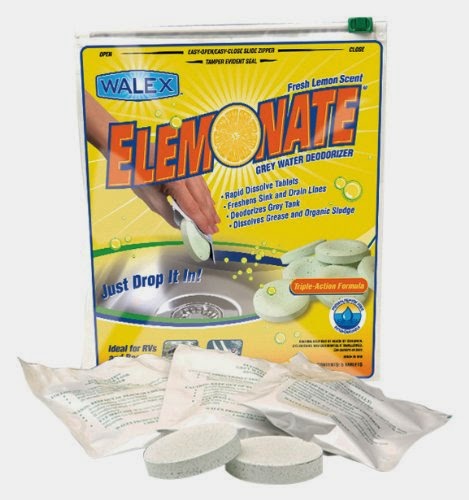
So what to do.  For the smell problem that might occur in the grey water tank, I use Grey Water Tank Smell Killer.  It works. You should put a cup of Dawn Liquid Dish Soap down the kitchen sink once a month to break up grease and oil in the Grey Tank and sink P traps.
Grey Water Tank Smell Killer

As for the water back-up, you should dump your grey tank every two days while camping or sooner if the water starts to back up.  This is the tank you can dump before you leave for home.
The grey water tank should be the last tank you dump before you head for home.  After dumping it you need to add approximately 1 gallon of clean water back into it and one of the grey water tank smell killers and you are good to go.
BLACK WATER TANK

Now the black water tank the scourge of RV camping.  There are a lot of does and don'ts about this tank so let's get started.
No matter what you hear or read almost all of the sensors that are supposed to tell you how full the black water tank is, do not work.  I have been told and it has been proven that the sensors mounted on the outside of the tank do seem to do a better job than those sensors that are inside the blackwater tank.  Most of the crazy ideas floating around about how to make the sensors inside the black water tank work also do not work.  To fix the problem of, the black water tank sensors and how full is the blackwater tank.  So, how do you know when it is time to dump the tank?  Look down inside the toilet and if you see blackwater, hear gurgling, and stuff floating, it's time to dump the tank.
 So what can you do to improve how the black water tank works.
Use only quick dissolving toilet paper in this tank.  Toilet paper made just for RV is fine such as RV 2ply Toilet Paper or septic tank safe toilet paper.  But you can use just about any toilet paper that will quickly dissolve.  To test any brand of toilet paper to see if it can be used,  take a glass jar with a lid.  Fill the jar about 3/4 full and add a single sheet of your toilet paper to be tested.  Put on the lid and give the jar three quick shakes.  If most of the sheet of toilet paper is broken up and coming apart you are ok to use the toilet paper tested.

Check here for more details RV Toilet Paper Safe.

We have safe paper what next?  How about something to get rid of the smell and help break down the waste. I would suggest a Black Holding Tank Deodorizer and Dissolver
Black Holding Tank Deodorizer and Dissolver

This should be added to your black water tank regularly.  I add one tablet after each time I dump my black water tank and another during hot weather if there is a smell problem.
Oxy-Kem 


Here is another possible black tank treatment Oxy-Kem that comes highly recommended.  I have not tried it so I can't comment on how well it works, but I do plan to and will let you know.  I did get a chance to try the Oxy-Kem.  However, it was not very successful.

Here is an all natural black tank cleaner that really cleans the tank as well as the sensors.  I have not tried it myself but all of the reports I am getting say it works. Unique Black Tank Cleaner  I have tried this black tank cleaner and found that I did not like it and have stopped using it.


Lately, I have been using Firebelly Outfitters, Tank Deodorizer.  I use two packs of the deodorizer per black tank.

I have used the product for several months now and have found positive results so far.  Another positive thing is that the people who make and sell this product are RVers.

Do not dump your black tank unless it is full or nearly full.  I know what you must be thinking but we never get it full over a weekend trip.  I realize that maybe the case but, you need to fill it up manually and dump it before you leave the park.
You do not need a hose or make this a big deal just flush the toilet and insert one of these things.
 Johnny Chock


Johnny Chock
          
Let the toilet run for approximately 10 to 15 minutes depending on how full your tank is.  If you can see the water in the black tank from the toilet that is full enough.  Remove the Johnny Chock and store.  Now dump the black tank like you usually do.  Add about a gallon or more of water (you can run the toilet with the Johnny Chock for 2 to 3 minutes and that should do it.  Drop in one of your black tank tablets and you are ready for the next outing.

Never leave the black tank drain valve open.  You are just asking for the smells of your neighbor's sewer to come up into your RV.  Or if you are really unlucky you could get the "black pyramid of death".  Because the liquid drains out of the open drain valve quickly the black solids are left behind and start to pile up.  If air gets into the tank from the open valve and drys out the solids you are really in trouble.  Or if you dump your black holding tank too frequently you will also have a build up of the solid waste.  This is a problem you do not want the black pyramid and could cause a very expensive repair.  To prevent the "pyramid of death" you need to flush your black tank when it is at least 3/4 full and refill it so that there is some water splashing inside as you drive back home.

One of the things you hear and I have tried is to add one cup of cheap dishwashing liquid soap to break-up waste and Calgon to lube the inside of the tank.  Does it work?  I have been using it and have not seen much of an improvement.  I plan on using this in the grey water tank next to see if it makes a difference to that tank.


Quick Guide To Waste Tank Dumping
  1. Grey Water Tank can be dumped anytime.
  2. Use a tank treatment when needed. (to reduce smell and add microbes)
  3. Dump Black Tank when at least 3/4 full.
  4. Add a small amount of water to both tanks after dumping. (up to 2 gallons)
  5. Use the grey water to flush out sewer hoses.


Until Next Time.


Monday, January 14, 2019

Improve Your Over The Air HD Reception

If you are RVing for just a weekend or full timing it, the chances are good that you will be with-in range of one or more HD TV channels.  The problem is that most of us just can't seem to get enough signal to watch TV.  Heaven forbid that it rains and you would need something to entertain the kids besides a good book.


Most RVs come with a crank-up antenna like the following.
While this antenna is a good one, it was designed for mostly VHF analog TV reception.  (The old style TVs.)  Most of the TV reception today is UHF digital and calls for a bit more antenna.
Winegard has solved the problem with the addition of the Wingman below.


This unit attaches to your current Winegard crank-up antenna and really does boost HD TV reception.  No special tools are required to attach it to your current antenna .  Just follow the instructions that are included with the antenna.
I have added one of these Wingman Antennas to my crank-up RV antenna and have really seen a major improvement in the number of channels that I can receive as well as the strenght of the signal on the channels that I could always get.

Let's talk about maintenance of your crank-up antenna.  At least once an RV season you should get up on the roof of the RV and lubricate all the swivel points on the crank-up mechanism.  I have used  White Grease in the past but this year I am going with T9 Lube which is a bit less messy than the white grease.

Now that you have a great HD TV Antenna you might need some help pointing your TV antenna for better reception of local stations, try this link: Maximize your television reception.  Follow the instructions,  just enter the zip code where you are, or use the map to place a pin where you are and the site will tell you the best direction to get the strongest local TV signals. Be sure to tell the program that the antenna will be mounted more than 30ft in the air to get all the TV channels.  Along with a list of the TV stations with-in range.

Have you read stories about RVers forgetting to crank-down their TV antennas and losing them to a tree?  Here is an idea to stop that.

This kind of idea has worked for me.  You could use some brightly colored ribbon and just write Antenna on it and attach it to the crank handle of the antenna and put a second reminder in the towing vehicle.  Anything to remind you to crank the antenna down.

Also do not forget to check the antenna amplifer switch is you are have problems with off the antenna reception.  When you switch from park satellite/cable you will need to turn the antenna amplifier back on.  Most RV parks request that you turn the antenna ampilifier off when hooking up to the parks system.


Until Next Time.


The Weekend RVers is a Facebook Group on RVing with Hints & Tips. A group for the Full-timer as well as the Newbie or Wanna B. In case U can't find us "Facebook.com/groups/Weekend.RVers" we are here hoping you will join us!

Monday, November 12, 2018

RV Humidity -- An RV Rig Killer!

A strong title, but true.  One of the major killers of RV walls is moisture in the form of humidity.  You don't even have to be using your RV it can be sitting in storage and humidity can still be present on the inside above a safe level.  Mold depends on moisture to grow and flourish. What is a person to do?  Well, the safe level of humidity for an RV is 40% or thereabouts.  So the first thing you need to do is know your current humidity level and the best way to know that is with a humidity monitor.


In the photo for the Humidity Monitor, the screen is showing 53% which is not acceptable for an RV.  The reading shown is more likely a Sticks&Bricks house.
Now that you know what the humidity is.  What can or should you do if it is not right.  You need to try and find out the source of the moisture causing the high humidity.  People give off moisture when we breathe, but getting rid of all the kids is not an option be they fur or not.

Next showers or taking a bath gives off moisture.  Be sure that the bathroom fan is turned on during the bathing process, even in the colder months.  Wipe down the shower and bath area to reduce the amount of moisture that is evaporated back into the air of the RV.

Cooking is another moisture generator.  Keep lids on pans when cooking, to keep the moisture down, open a window a bit to let the warm moist air out, and turn on the kitchen vent if you have one.  Many of the newer RVs do not vent the stove vent to the outside.  This is not good, as an inside vented stove hood keeps the moist air inside the RV.  Do not let a tea kettle steam longer that is necessary.  Don't leave a coffee pot running all day long.  Make a cup as you need it or the coffee pot will add to the humidity in the RV all day long.

Try to locate any seals in the RV slides that is letting in outside air and seal that area.  You can cut strips of foam insulation like Reflectix or other foam insulation.  If you find caulking around the tub or shower stall or even around the kitchen/ bathroom sink is missing or cracking re-caulk using 100% silicone sealant like shown below.  This keeps water from going in the RV wood structure or supports where, if conditions are right, mold will start to grow.

If it is during the colder months and your RV has single pane windows you might add Bubble Wrap to the windows.
To install the bubble wrap do the following.

Cut the bubble wrap to the size of the window pane with scissors.
Spray a film of water on the window using a spray bottle.

Apply the bubble wrap while the window is still wet and press it into place.
The bubble side goes toward the glass.
To remove the bubble wrap, just pull it off starting from a corner.

This bubble wrap will help insulate the inside of the window from the outside of the window to further reduce moisture forming on the inside of the window when the outside air is colder than the inside air.

Do you dry clothes in the RV by hanging them in the bathroom?  Did you remember to turn on the exhaust fan?  It is not wise to dry clothes in the RV during the colder months because drying clothes adds to the amount of moisture inside the RV.  Do you have a combination washer/dryer?  Make sure the dryer is vented to the outside.  If you do not the dryer will add to the moisture in the RV.

If it possible let the RV inside temperature drop a bit in colder weather so the air inside the RV will hold less moisture.  Cooler air holds less moisture than warm air.  You may have to dress a bit warmer, but your RV investment will thank you for being a bit cooler.

Poor air circulation inside the RV can make mold grow in drawers, closets, and even cabinets.  Keep the air moving even when you are not inside your RV.  How may you ask? You can open two or more roof vents or a roof vent and crack a window so that air naturally flows in and out.  You can add a MaxxAir vent cover

over your current roof vents so that you can keep your vents open without rain or snow coming in the RV when the roof vent is open. You should put your RV in storage with vents cracked a little bit to allow for air movement.

If your RV does not have LED lighting you could swap out your current incandescent light bulbs for the LED equivalent.  This will reduce the about of air heating that the hotter incandescent bulbs are known for.  There is an LED replacement light for most all of the RV incandescent bulbs used in RVs. As an additional benefit, your RV battery will last longer during dry camping with LED lighting and depending on the LED light you buy you may find that the inside of your RV is now brighter with the lights on.

OK, we have talked about what not to do and some of what you can do to reduce moisture in the RV now let's get serious about stopping or greatly reducing moisture in your RV.
1. Get a dehumidifier.  They come in several sizes and types.
The ezest one to do business with is the bead type.

Twin Pack resealable packaging
100% silent operation
Lasts 45-60 Days
Indicator beads let you know when it's ready to be discarded.

You can spot these around the RV and in closets, cabinets, drawers where ever you feel or think moisture may be lurking.
Next, you have the mechanical dehumidifiers.

Whisper quiet
Renewable reservoir
Compact size is perfect for bathrooms, closets, and R.V.s
Low energy consumption
One of these usually works but if you have a severe problem you may want to consider two of them.

If you have an RV more than 36 feet long you may want to consider this one.

Squeezes Up to 20 oz. of Water a Day From Humid Air
Very Quiet Operation Due to No Moving Parts
At Capacity, Indicator Lights Up and Device Shuts Off
Compact at 4.45 pounds, 6.8" x 8.5" x 14"
For bunkhouse RVs,  you will need two.

And if you really need more moisture removal you can use a sticks and bricks type unit.
Removes up to 70 pints of moisture from the air per day
1.3-gallon water tank with transparent water level indicator, full bucket alert, and automatic shut-off when full
Removable, easy-cleaning dust filter with a clean filter alert
4 durable, rolling casters for easy movement

 It is generally felt that combinations of dry and mechanical work the best.

Well, that should about do it for this topic.  I hope you found the information helpful and can use some of the ideas presented.

Until Next Time


And finally, please remember that this blog is an Amazon affiliate. When you order something through any of the Amazon links, it doesn’t add anything to your cost, but I do earn a small commission on everything you buy. Just click on an Amazon link, then shop as usual.

Friday, July 27, 2018

Pressure And More Pressure On Your RV's Water Lines

Are you putting to much water pressure on your RV's PEX water lines and their PEX fittings?  Do you know how much pressure you can put on your RV's water lines and their  PEX fittings?
Let's take a look and see what's what.


RV manufacturers typically use PEX  PlasticTubing for all RV plumbing runs. The two sizes are commonly used, 3/8-inch and 1/2-inch. These are the standard size because the outside diameter of the tubing is about 1/8-inch greater than the called-for size. Red PEX is usually the Hot water line and Blue or Clear the cold water line.  But, not always.  There are special fittings used with this type of water line called PEX fittings.  Below are some examples of some fittings you might see under one of your sinks.

The fittings can be of any color or even colorless but they will all have the ribs you see on the fittings above.  You will also note that each PEX fitting has a crimped ring around it.  The ring looks like below.
To put the ring on the PEX tubing and secure the ring you would need a crimping tool.  Shown below.
OK, now that you understand what you currently have let's discuss the problems this type of system brings the RVer.  The whole system can leak at any time and usually does. Every connection, if it is not put on correctly, will leak at the worse possible time. Ah, you say no problem I will just squeeze the ring with my trusty pliers.  Well, your trusty pliers will not be able to squeeze the connector hard enough to seal the leak in most cases.  What to do?  Change the fitting to a more updated connector.  We will cover that in just a minute.

Why do these cheap PEX products not work well all the time?  PRESSURE, water pressure from campgrounds varies greatly and can not.  The PEX water system in an RV cannot safely go above 65 pounds of water pressure.  I will not allow mine to go over 55 pounds of pressure.  
How do I control the RV Parks water pressure with a brass water pressure regulator
Brass RV Water Regulator
 You can adjust this type of regulator to any safe water pressure you like for your RV.  This type of regulator does not affect the flow of the water just the pressure. There are lesser expensive water pressure regulators like the one shown below.


While this type will regulate the water pressure it also affects the flow of the water which some people find objectable.  Either one will protect your RV water system from to much PRESSURE.

OK, you just found a PEX fitting under the kitchen island that is leaking now what can you do to fix the problem and how much time is it going to cost you?
You should carry a few Shark Bite connectors like the ones shown below.
Shark Bite Coupler

Shark Bite T

Shark Bite to Threaded 
There are even more fittings to choose from but you get the idea.  The advantages of these types of connector are, 


  • INSTALLS IN SECONDS: 1/2 inch straight coupling requires no special tools, no soldering, no crimping or glue. Just push to create a watertight seal
  • COPPER, PEX, CPVC: SharkBite straight coupling plumbing fittings fits copper tubing, and CTS CPVC and PEX and connects all three types in any combination
  • CERTIFIED: SharkBite fittings are certified to 200 PSI and 200°F and can be reused up to four times

Now doesn't that beat the PEX connector and all the fuss it would take to fix a leaky connection?
The real story here is to control your water pressure coming into your RV.  If you do not you will find leaks and under the shower or under sink water damage.  
One other thing you may want to add a water shutoff to your toilet so in case you need to work on it you do not have to shut off all the water to the RV.

Shark Bite Shut Off


Until Next Time


And finally, please remember that this blog is an Amazon affiliate. When you order something through any of the Amazon links, it doesn’t add anything to your cost, but I do earn a small commission on everything you buy. 
Just click on an Amazon link, then shop as usual.

Wednesday, January 31, 2018

RV Dog Bones and Adapters

Many times as you travel around the country you will find that you are in need of some sort of thingy that changes what you have into something you need.  This happens most often on the electrical side of your Rig.  If you have a 50 amp rig you may find that the campground you have only has 30 amp plug-ins.  Or you may want to plug in your power pedestal power analyzer into the 30 amp or 50 amp plug-in to be sure that it is safe you plug into your rig.


Let's see what these things look like and what they are used for.  First the RV Dog Bone.
The typical RV Dog Bone is an electrical adapter that changes a 50 amp RV plug so that it can plug into the 30 amp socket of a power pedestal. The 30 Amp Male to 50 Amp Female Dog Bone  looks like this;

30 Amp Male to 50 Amp Female Dog Bone  
Of course, there may be a time when you need to plug your 30 amp Rig power cable into a 50 amp power pedestal socket  The 50 amp Male to 30 amp Female Dog Bone looks like this;

 50 amp Male to 30 amp Female Dog Bone 
Plugging in you 30 amp RV into this adapter will not harm your Rig and will give you no more power than what you should have. The reason to do this is often the power socket on the power pedestal is worn or broken and the only good one is the one your power cord will not plug into.  These RV Power Dog Bones let you mix and match to get some power.
So you have stopped by Grandma's house to spend a few days and you need a way to plug your RV into her outside power socket so you can get some lights and keep the fridge going.  What do you need well you need a 15 Amp Male plug to 30 amp Female plug . This little gadget is shown below.


                                                15 Amp Male plug to 30 amp Female plug


While these may not be all the ones you will ever need this group will get you started and cover most of the situations that you will find.  One last bit of information the industry does make Y connector so that you can get 15 amp sockets from both 50 amp and 30 amp outlets from the power pedestal.  I have shown one type below.  I do not use these myself because where I camp has always had 15 amp sockets to plug into if I need to have 15 amps at the power pedestal.  If you have a blow-up boat or kayak you might need this type of Y Adapter with 50 Amp Male Plug To RV 30 Amp and 15/20 Amp Female Connector  Shown below is what it looks like;

Y Adapter with 50 Amp Male Plug To RV 30 Amp and 15/20 Amp Female Connector

I would like to cover the pedestal power combiner.  These devices combine the power outlets of the power pedestal to give you more amps.  For example, if you combine the power output of the 30 amp socket with the power output of the 15 amp socket on the power pedestal you would get 45 amps of power to work with.  Or at least that is the theory.  Again I do not use this type of device as my Open Range 5th Wheel is 50 amps.  But to be fair I am showing you the device. The 45 amp Power Maximizer  The unit is shown below;

The 45 amp Power Maximizer  
Here is a power dog bone that I use all the time.  It is a 50 Amp right angle power adapter that takes the stress off of the power plug mounted to the trailer


Here is the 30 Amp version as well.


Click on the name of the item to learn more. 


Until next time,


Please remember that this blog is an Amazon affiliate. When you order something through any of the Amazon links, it doesn’t add anything to your cost, but I do earn a small commission on everything you buy. Just click on an Amazon link, then shop as usual.

Thursday, February 23, 2017

Is It Level??? Is It Stable???

Is It Level??

How many times have I heard that phrase at a campground?  I can't even count them or remember them for that matter.  How do you know when your rig is level and what can you do if your rig is not?
Let's look at some of the possibilities.


The first thing you need to do is eyeball the site that you will back into or pull forward into.
Does the site appear flat?  There could be a drainage crown to the site, meaning that the center is higher than either side so that the rainwater will drain off quickly if it does rain.
Maybe there is a slope in the site toward the right or left.
All of this needs to be taken into consideration when looking at the site.
Ok, you are pulling or backing into the site and you have the support of a ground crew so getting into the site is not the problem.  The door side of the rig appears lower that the street side or is it?   How do you know? Well at some point in the life of your rig someone should have put bubble levels on it.
(For you guys with money we will discuss auto leveling equipment at the end.)

They should look like theses RV Bubble Levels
RV Bubble Levels 
If you have nothing, or what you have is so small as not to be readable then an up-grade is in order.  You should mount one of these in the front of the rig where the level can be easily seen, after taking the rig to a Walmart type parking lot and using a construction level, checking that the rig is sitting truly level before you mount the above levels to the rig.  The second level is mounted on the street side of the rig at the same height that you mounted the front of the rig level.  Be sure you have confirmed that construction level and the RV level agree that the rig is level.
Why you ask?  Because if you are more that 5 degrees out of level your RV refrigerator may not work or will not work efficiently.
But you may not have a TT maybe you have a 5th wheel and need something a bit bigger.  Enter the 5th wheel bubble level.  This is mounted on the pin box so you can see the level from the driver's seat.
Even if you have auto-leveling on your fiver you want to start out as close to level as you can so as to not put to much stress on the self-leveling system.

Ok, you have found that the door side of the rig is low and needs to be raised up to bring that side into level.
Now the fun begins.  You will need to put something under the wheels to raise that side of the rig.  You will need what is called an RV Tire Leveling Block,
RV Tire Leveling Block
These blocks interlock so they will stay put if more than one is used and they are designed not to sink into soft soil or blacktop.  Just how many you will need to level up the low side is often just simple trial and error.
I always start with one above ground level under each tire on the low side and go from there.  Let's say that you needed two under each tire on the low side to get level.

Did you remember to pull up on them and not try to back up on them?
Better for the tires if you pull up on the leveling block rather than backing up on them.

Also, did you make sure all tires were centered on the blocks, not on an edge?
The axle of the tire or the hub in the middle of the tire should be centered on the leveling block.
Why? Because it puts less stress on the tires, that really do not like being off the ground in space.

Here is yet another way to level your Rig.  This one is a bit different that the square block used above, this one is a Ramp Style Leveling System and will help you level your rig from any increment between 1/2 inch and 4 inches.  This ramp style will hold up to 30,000 pounds.  If you have two axles then you will require two ramps per side.


The smaller ramp is used to chock the RV from moving once the RV is level.  The ramp with the holes in it, is the adjusting ramp. 

You have checked the levels on both the front and side of the rig right?  So now what?  You need to check that the fridge is level. On way to do that is to use a Torpedo Level
 Torpedo Level
This small 8" level can be used inside the fridge or on the nearest counter next to the fridge to check to be sure that the fridge is level. (Level - not more that five degrees out of level, is very important to the good, safe, and efficient operation of an RV fridge)

You are now level so what is next? Unhooking and stabilizing the rig.
Once you are unhooked you need to put down the corner stabilizer jacks.  Most travel trailers use Scissor Jacks
Scissor Jacks
This type of jack is NOT for leveling your rig.  It is to keep the rig from moving back and forth as you move around inside.  If one of the jacks does not meet the ground you can use one or more of the tire leveling blocks to help stabilize that corner of the rig.  As shown in the above photo a hand crank is the normal method of deploying this type of jack and can be a real pain.  There are two fixes for the hand crank used on these jacks.  One is the Stabilize Scissor Jack Socket for an electric or battery operated drill.
stabilizing Scissor Jack Socket
The second but more expensive way is to motorize RV scissor stabilizing jacks
Bearing Protectors-1.78" Hub Diameter, Stainless S
motorized RV scissor stabilizing jack
This jack is remote controlled and is powered off the rig so it makes the stabilizing fast and easy.

Many of the newer 5th wheels will have will have powered corner jacks and landing jacks.  Some will have auto leveling that will level and stabilize the fiver.  But what happens when you are still getting sea sick from someone walking inside the fifth wheel or travel trailer?
For the 5th wheel, there are several things that can be used and have had success.
First is the Stabilizer Jack
I use these back at the bumper, where the bumper joins the frame of the fifth wheel.  The use of these has really made a difference in the movement of the trailer.

Next is the expandable wheel chock or X-chock.
This chock does double duty if you use a paddle lock to lock the chock from being removed it will stop someone from being able to steal your RV with-out a lot of work.

Your rig is now level and corner supported but, when someone walks around the inside of the rig it still does the shimmy, shimmy, shake.  Now what?  There are many suggested solutions out there to solve this problem but here is the simplest one that works.  The RV Stabilizer         

RV Stabilizer   
One of these can be added to the rear of the rig to stop side to side motion and or one can be added to the side of the rig to stop the front to back motion.  This looks simple and it is but, it does work.

The X-Chock from above will also work on Travel Trailers to help stop motion and help to prevent theft as well.

OK, now for the guys with money.  If you would like to add remote control automatic power leveling jacks to your TT or 5er, the following is a company that has received good reviews for their lift systems; Big Foot Leveling System
Big Foot Flip Down Leveling Jack for TT

The type of DIY that is required to install this system is not in the scope of this blog.  But this type of wireless remote control system is out there and for those who would like to add automatic power leveling to their rig here is a place to start.


Until Next Time

And finally, please remember that this blog is an Amazon affiliate. When you order something through any of the Amazon links, it doesn’t add anything to your cost, but I do earn a small commission on everything you buy. Just click on an Amazon link, then shop as usual.