Showing posts with label RV Hitch. Show all posts

Friday, June 15, 2018

Propane Gas Saving Ideas

I am sure most of you have noticed that gas of all kinds including diesel fuel is going up in price.  Many of us would like to stretch our Propane Gas as far as possible.  Well, there are some basic tricks of the RV lifestyle that can help you do just that.  You must have access to AC power (shore power) to make these tricks work.


The first one has to do with your hot water heater.  If your unit is a dual operating type (AC and Propane) force your unit to use AC whenever possible by shutting off your propane tanks. Turn your hot water heater off overnight.  The tank will keep the water hot to warm all night.
But your comment is, how will I cook anything?  The answer to that follows.

Second is to use induction cooking.  An induction cooktop uses magnetic energy to heat and cook whatever is in a pot or pan that a magnet can stick to.  For example, this Deluxe Burton Induction Cooktop is what I have and it works just great.  This is what it looks like;

Deluxe Burton Induction Cooktop


Here are some of the features of this Induction Cooktop ;
  • 1800-watt high-quality induction cooktop provides 10 power levels
  • Push-button controls and digital display; 180-minute timer with auto shut-off
  • 10 temperature settings; overheat sensor; in-line fuse
  • For use with induction-compatible cookware; the unsuitable-cookware detector
  • Measures 13-2/7 by 12-1/2 by 2-3/5 inches


As mentioned in the features of the cooktop you must use cookware that a magnet will stick to.  Most cookware today is aluminum and so would not work.  You do not need a completely new set of cookware just enough to get by with using the induction cooktop.
Here is an example of Induction Cookware shown below;

Induction Cookware 

Any cookware will work as long as a refrigerator magnet will stick to the bottom of the pan or pot.  Here is a chance to go to Goodwill or other secondhand shop and make a killing on induction ready cookware.  Just be sure to bring your refrigerator magnet with you.

But you are a baker by trade and need to often use the oven that came with your Rig for that purpose.  What are you to do?  Well let's look at a solution called the Infrared Countertop Oven shown below;

Infrared Countertop Oven

Some of the features of this innovative oven are shown below;

  • Digital-controlled infrared oven cooks food quickly and easily
  • Cooking methods include conduction, convection, and infrared radiant heat
  • No preheating, defrosting, or ventilation needed; dishwasher-safe parts
  • Extender ring, cooking rack, baking pan, manual, and recipes included
  • Measures approximately 14 by 14 by 16 inches
  • 3-inch Extender Ring, 2-inch rack, 10-inch baking pan 
  • Cooks up to a 16 Lb. turkey /141b ham with Extender Ring

So now we have the baking taken care of and we are not cooking with gas but electricity and so are saving gas and bucks ($). 

I heard you lady in the back row.  You are cold at night and need some heat so turning off the Propane gas is not an option.  Let's look at some options here as well.  
You could put one of these Mattress Heating Pads on your bed and plug into electric and sleep warm as toast all night.  These heated pads come in all the popular sizes King, Queen, and Twin.  I have shown the queen size below;

Mattress Heating Pads
Because heat rises this mattress type heating pad is much better than a heating blanket and will use less power to keep you toasty warm during the cold night. 
Ah, but you need to heat the Rig so you need more power, I mean heat.  Then you want a Ceramic Space Heater  This type of heater generates a lot of heat for very little electricity used.  The one pictured below is what I use.  I have a 30ft TT and use two of the Ceramic Heaters. One blowing toward the bedroom and one in the living room blowing toward the kitchen.  These heaters will cook you out of the Rig, they can generate so much heat.  I winter camp in North Texas and it can get below freezing, as we all found out in the winter of 2013/2014.  But even though my water hose froze outside, inside we were as warm as toast.  Shown below is the  Space Heater I have;

I have listed some of the features of this unit below;
  • Ceramic space heater with adjustable thermostat for comfortable warmth—ideal for home or office
  • 1500-watt high setting; 3 output options: Low, High, or Fan Only; power indicator light lets you know when it’s plugged in
  • For safety: tip-over switch with auto shut-off and overheat protection with auto shut-off; ETL listed
  • Carrying handle for easy transport; not for use in bathrooms, laundry areas, or other high-humidity rooms

      If you have a four-legged friend (Furkid) traveling with you, please take note: this unit comes with Auto Shut-Off.  If the Ceramic Heater is tipped over the heater shuts off automatically.  This is a very important feature if you are traveling with four-footed friends.  There are some clumsy two-legged friends out there as well.

      Again I remind you that these LP Gas saving tips only work if you have access to a power pedestal so you can get AC power.  With these hints, the Propane Gas becomes the backup plan and not the main source of energy for your Rig.  I know from experience that these hints and tips will work.


      Until next time.


      And finally, please remember that this blog is an Amazon affiliate. When you order something through any of the Amazon links, it doesn’t add anything to your cost, but I do earn a small commission on everything you buy. 

      Thursday, April 26, 2018

      Let's Check Those RV Tires Again!

       While some of us are still digging out of the winter storms, some of us are dreaming about the first warm weekend of the new camping year. So what do you do first with your stored RV?  Check the tire pressure with a good tire pressure gage.  The tire's max pressure is located on the side wall of the tires on your RV.  Do not use the pressures recommended by the RV manufacture UNLESS the RV has the original tires that it came with from the factory.


      I use both a screw-on tire pressure indicator, such as Quick-Pressure-PSI-50-Monitor, which at a glance can tell you that you may have a problem [use only if your tires are supposed to have 50 lbs of air when cold. Other pressures are available]  and the traditional pencil like gauge, such as Pencil-Pressure Gauge
       Be sure to test or look at the tire pressure gage before you have moved your RV a mile.

      You need to check the tire pressure when the tire is still cold
      Another good, but pricey, system for monitoring your tire pressure as well as the tire temperature is the  Wireless Tire Pressure Monitoring System. I am saving for this one.

      Wireless Tire Pressure Monitoring System

      The system will tell you of an overheated tire, in most cases before it blows, and of course tell you of low pressure in any monitored tire, even the spare,  in real time no need to stop every 20 miles and check those darn tires - LOL.  When you stop for gas or a bathroom break you should do a tire check of the RV as well as a tow vehicle. My daughter was checking the tow vehicle for me and found a large cut in the sidewall of the truck tire.  We were able to get the tire replaced before the large accident occurred.  I did not even remember hitting or running over anything on the highway.
      Be sure to carefully look at the tread, and the side walls both on the front and the back of the tire.  Most RV tire experts agree that if your tiers are more than five years old from the date of manufacture you should replace them.  Most tire failures occur when the side wall of the tire is under inflated or rots out from the inside where you can not see.  You can thank Mr. Sun for sidewall failure in some cases.  Most tires have a Sun inhibitor built-in but when a tire sits and sits the inhibitor does not get moved to the outside of the tire by the tire going round and round.

      Now you see why you need wheel covers right? Trailer Wheel Covers for less than $25.  To protect the tires in storage from Mr. Sun and any other nasties that come along.
      You can also use an RV tire protective spray which is applied, as directed, to the tire sidewall that is exposed to the sun.  I have used RV Tire Protection Spray with good luck.  This spray is NOT designed to make the tire sidewall shinier, it is not a decorative spray, but something that is designed to put back into the surface of the rubber what Mr. Sun is taking out.
      RV Tire Protection Spray
      Also, note that if you are going to store the RV for an extended period of time you should protect the tread from the surface that the tires are sitting on.  Nasty things can leach out of your tires into the blacktop or concrete that your RV sits on while being stored. Or from the blacktop or concrete into your tires during storage.  You can use an  Office Chair Mat that sells for less than $20,
      for each side of the RV and just back onto it as you are putting the RV away.
      Or you can Go to Tractor Supply or any farm supply and pick up horse stall mats

      Cut to the size you need for just $20.  Now that is easy.

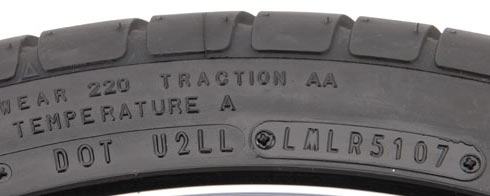
      If you are supposed to replace your tires every five years how do you know when your tires were made?  There is a code date molded into the side wall of the tire. (you can thank our government)   The National Highway Traffic Safety Administration (NHTSA) requires that Tire Identification Numbers be a combination of the letters DOT, followed by ten, eleven or twelve letters and/or numbers that identify the manufacturing location, tire size, and manufacturer's code, along with the week and year the tire was manufactured.  Since 2000, the week and year the tire was produced has been provided by the last four digits of the Tire Identification Number with the 2 digits being used to identify the week immediately preceding the 2 digits used to identify the year.

      Below is an example of a tire manufactured since 2000 with the current Tire Identification Number format:

      In the example above DOT U2LL LMLR 5107
      DOT U2LL LMLR 5107 Manufactured during the 51st week of the year
      DOT U2LL LMLR 5107Manufactured during 2007
      While the entire Tire Identification Number is required to be molded onto one sidewall of every tire, current regulations also require that DOT and the first digits of the Tire Identification Number must also be molded onto the opposite sidewall. Therefore, it is possible to see a Tire Identification Number that appears incomplete and requires looking at the tire’s other sidewall to find the entire Tire Identification Number.
      I know you are saying to yourself,  but the RV is only three years old.  We are not talking about the year your RV was built, but the year the tires were manufactured and they may be not the same so please check.   If your tire's serial number cannot be read by you, then you need to take the tire or RV to an RV dealer or tire shop and have the tires read.  Please do not be pulling your RV with old tires that may jeopardize your families safety as well as others.   [If you want more information on tire markings and such go to Tire Tech Information]

      Ok, you have checked the date code of your tires and they are in fact only three years old.  Tire pressure is up and you're ready to go.  Not so fast!

      We need to discuss lug nut tightness.  Each Spring or before a major trip you should check the tightness of the lug nuts on each of the RV tires.  You need to check your owners manual for the correct setting.  My 5er has the specifications of 100ft LBS.  I use an inexpensive torque wrench, which I keep in the RV toolbox, to confirm the setting. 1/2' Torque Wrench  To keep the wrench outside of the tire rim I also use an extender. 1/2" Socket Extension The socket size depends on your lug nut size.

      Tire Check Quick Guide 
      1. Check all RV tires for max pressure listed on the tire sidewall.
      2. Check tire tread and sidewalls for wear and cracks.
      3. Cover tires from sun damage when not using.
      4. Keep tires off of storage surface during storage.
      5. Check the age of tires yearly.
      6. Check your tires every time you stop.
      7. Do maintenance on your tires as needed.
      8. Check lug nut tightness.


      Until Next time.